The empty room
A table, a chair, a bottle, a shot glass and a clock. The rest of the house exists only in the audience’s imagination. The empty space becomes a kitchen, a refuge and a place where an ordinary day slowly turns into legend.

All it takes is a single word spoken in anger
and noon will never be the same again.

The Noon Witch | mythical being
THE NOON WITCH is a darkly grotesque theatrical miniature inspired by Karel Jaromír Erben. Jiří Suchý, and later Otto Weiss, took the liberty of “gently” reworking his words, transforming the folk legend into an absurd cabaret about anger, guilt and one visitor who should never have been summoned.
In a tiny room, between a table, a chair, a shot glass and a clock creeping dangerously close to noon, an ordinary domestic argument turns into a mythical catastrophe. One sentence is enough — and the Noon Witch is standing at the door.
The production works with empty space, the audience’s imagination, fairground exaggeration and sharp humour. Horror meets farce, Erben meets Suchý, and the light of noon collides with dark purple absurdity.

Here, the folk ballad breaks apart into an empty room, imaginary characters, fairground exaggeration and a noon that arrives at precisely the wrong moment.
A table, a chair, a bottle, a shot glass and a clock. The rest of the house exists only in the audience’s imagination. The empty space becomes a kitchen, a refuge and a place where an ordinary day slowly turns into legend.

The child never appears on stage. It exists only in the music, the actors’ glances and the precisely choreographed interplay with empty space. Each audience member therefore creates their own image of the child who simply will not stop misbehaving.

Erben’s ballad enters the world of fairground cabaret, where folk song meets dark grotesque and the harsh music of the invisible child. The horror never disappears — it simply learns how to become dangerously funny.

Instead of the expected spectre, an extravagant lady arrives, resembling a bureaucrat from another world. Purple elegance, self-assurance and a peculiar practicality transform the familiar mythical being into a perfectly absurd visitor.
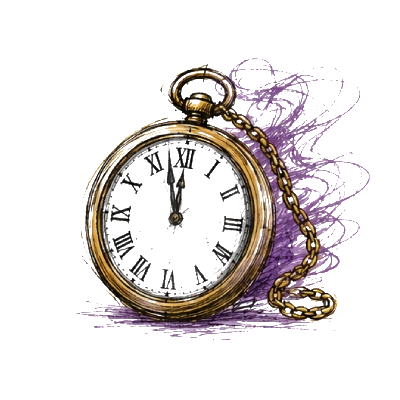
A large clock dominates the stage, serving as far more than a prop. It measures the tension, sets the rhythm of the scene and reminds us that sometimes a single movement of the hand is enough for a spoken threat to become reality.
Photographs from this production are unpublishable.
Therefore, this gallery contains not a single trace
of this gigantic miniature.

Two actors, one mother, one Noon Witch
and the audience’s imagination were enough to do the rest.
The fairground singers opened the story, and those same performers then transformed into the central characters of the ballad they brought to life before the audience.
Some words are better left unspoken.

Costume, prop and visual concept designs,
that helped shape the world of this modern adaptation of Erben’s The Noon Witch.
Some stories are told for generations.
All it takes is to speak a single name…
and someone may come again.